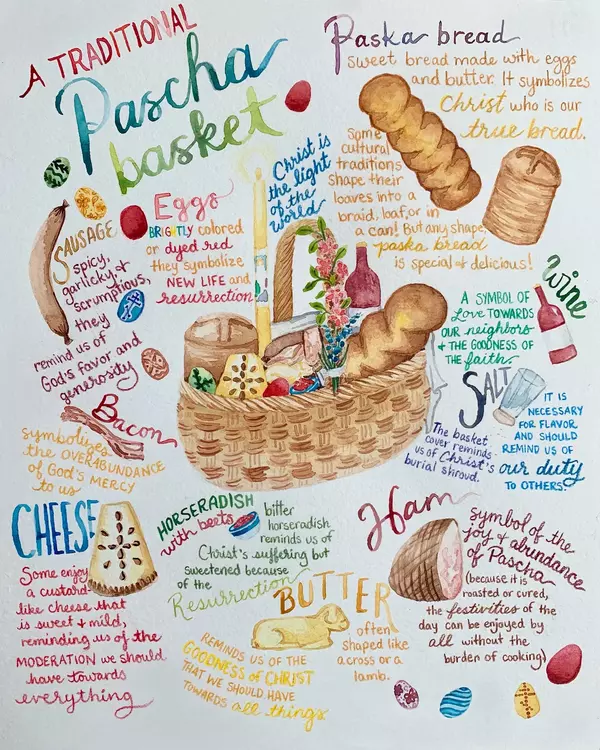
Please bring your basket to the front of the church before the service begins
As Lent comes to a close, the cherished custom of the blessing of the Paschal food eaten on Easter Sunday is observed. Each of the traditional foods has a symbolic and spiritual significance. Although these particular items in the basket have a long standing tradition, they are in no way required. Each person / family puts together a Paschal basket that is unique and special. It is common that family members will include items that they have been abstaining from during the Lentenfast, and items they are most looking forward to breaking the fast with after Pascha! (Consider asking each member of your family what items they would like to include in your family basket.)
A blessing will be offered as part of our celebration liturgy at St. Augustine’s on Easter Sunday 10am. You are welcome to join in, this will prove a fine way for you to enter into the liturgical act of Easter. Kids may bring a basket of goodies to be blessed as well!
Option A - Traditional items, listed below, which gather up the whole story of Christ's Passion in their symbolism. You may decorate the basket with greens and embroidered cloth.
Option B - A selection of items from your own traditions that you will eat for Easter brunch/dinner. Decorate the basket in your own style, add a candle and a nice cloth. You may wish to include some of the traditional items as well.
- Eggs : Brightly coloured or dyed red, they symbolize new life and the resurrection. The red egg, which we crack, reminds us of the tomb from which Christ arose. This is because of the miracle of new life which comes from the egg, just as Christ miraculously came forth from the tomb, shattering the bonds of sin. Of course, red for His blood shed for us, and the miracle from St Maria Magdalane when the egg in her hand miraculously turned red as she proclaimed "Christ is Risen" to the non-believing Emperor. Pysanky is a Ukrainian Easter egg, decorated with traditional Ukrainian folk designs using a wax-resist method. The word pysanky comes from the verb pysaty, "to write" or "to inscribe", as the designs are not painted on, but written (inscribed) with beeswax. Dyed Red Eggs in the Greek tradition, Holy Thursday is the day designated to dye red eggs. The red color is symbolic of Christ’s blood, and since Holy Thursday evening’s service (which is done in anticipation of Friday) is the day when Jesus is nailed to the cross, the many choose to dye their eggs on this day. Many churches provide red eggs for the faithful, which are then distributed after the Paschal Liturgy.
- Bread (Paska) : A sweet yeast bread rich in milk, butter and eggs. The bread reminds us that Jesus is the 'Bread of Life' (John 6:35). Paska is traditionally round in shape with a dough braid around the perimeter and an ornamental cross in the center which marks the means of the death of Jesus.
- Lamb-shaped Butter : Represents Christ as the "Lamb of God". Symbolic of the goodness of Christ. Butter can also be shaped like a cross.
- Smoked Meats/Sausage : Symbolize God's abundance, joy, and the sacrifice of Christ. Meat products represent the sacrificial animals of the Old Testment, foreshadowing the true sacrifice of our Saviour, who became for us "the Lamb of God, taking away the sins of the world." As we learn from the prayer of blessing, the meat products also represent the fattened calf prepared for the Prodigal Son on his return to his Heavenly Father. Specifically: Sausage - spicy, garlicky and scrumptious reminds us of God's favour and generosity. Bacon - the overabundance of God's mercy. Ham - the joy and abundance of Pascha.
- Salt: Represents purification, prosperity, and reminds us that we are the salt of the earth (referenced in Matthew 5:13-16) “You are the salt of the earth; but if the salt loses its flavor, how shall it be seasoned? It is then good for nothing but to be thrown out and trampled underfoot by men.” Salt is also necessary for flavor, and reminds the Christian of his duty to others. As salt preserves food, we are to be as salt in the world.
- Horseradish : Symbolizes the bitter sacrifice of Christ. In some traditions the horseradish is mixed with grated red beets, this is symbolic of the Passion of Christ still in our minds, but sweetened with sugar because of the Resurrection. A bitter-sweet red mixture reminds us of the sufferings of Christ. Having a bitter herb also reminds us of the vinegar that was offered to Christ while he was on the cross.
-
Cheese : Often creamed and presented similar to butter. A reminder to live in a life of balance and moderation.
- Wine : Reminds us that God takes ordinary food and uses it as an aid in making us holy. From Matthew 26:27-29 “Then He took the cup, and gave thanks, and gave it to them, saying, “Drink from it, all of you. For this is My blood of the new covenant, which is shed for many for the remission of sins. But I say to you, I will not drink of this fruit of the vine from now on until that day when I drink it new with you in My Father’s kingdom.”
- Candle : Inserted to represent Christ as the "Light of the World". Traditionally this candle is placed in the middle of the table during the eating of the Pashcal meal. It is a symbol of Jesus who is the true light who brightens the whole world through the radiance of His Holy Resurrection.
-
Linen Cover : Symbolizes the shroud of Christ. Usually a white cloth that is either plain or embroidered.
One of the most profound things is the Church takes ordinary food, blesses it, and it is used as an aid in making us holy.